

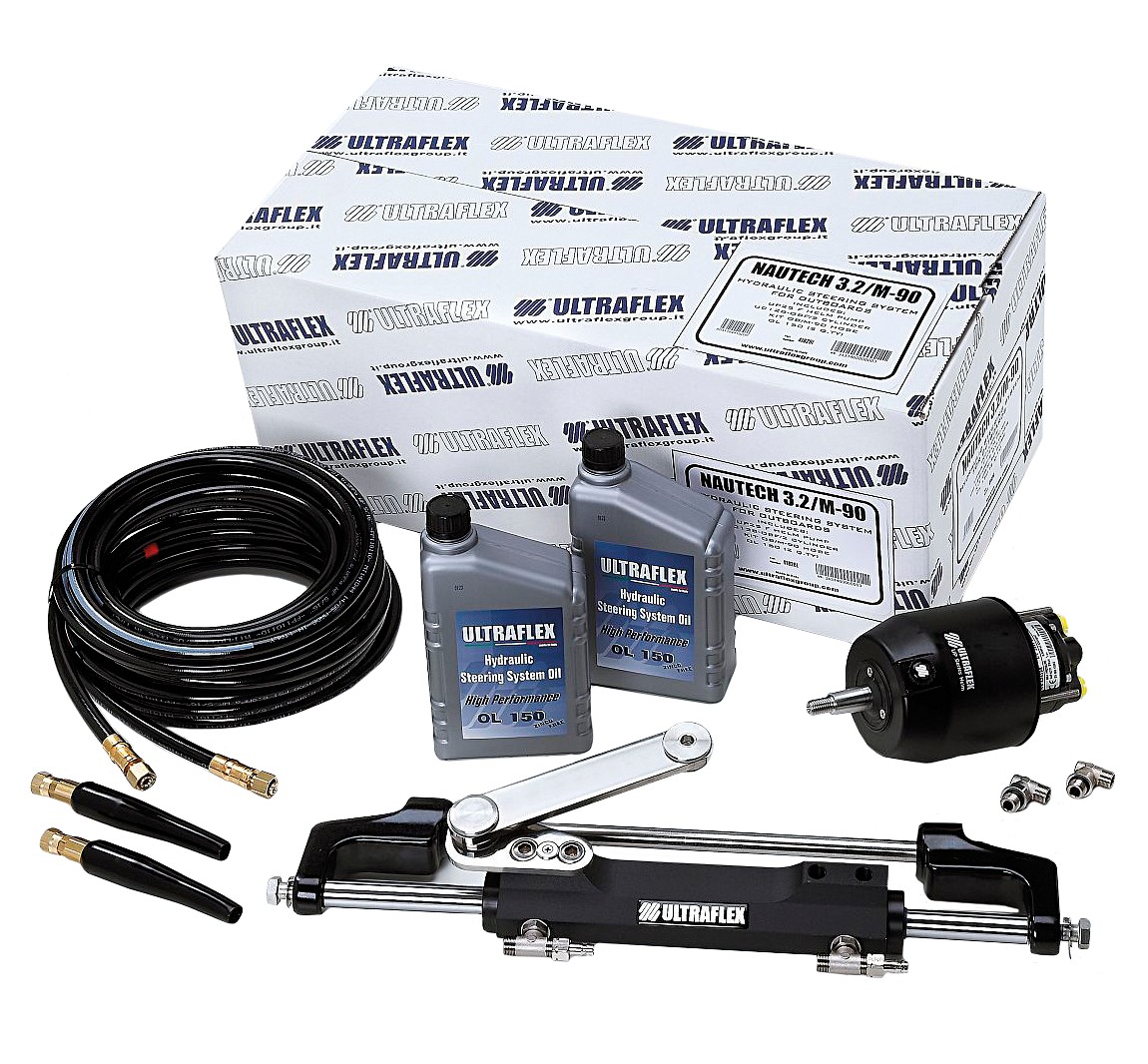


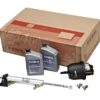
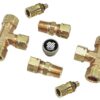
The package includes a 9 meter hose set, a connector pressed into one end of the hoses, and connectors that can be easily attached to the free end of the hose yourself. Steering 5.1 turns, with the cylinder’s full travel.
Contains:
• 1 pc UP25F hydraulic pump, output 25 cm³, working pressure 70 bar
• 1 pc UC128-OBF/1 hydraulic cylinder, volume 128 cm³, stroke 185 mm
• 2 pcs 9 m KIT OB/M-90 Ø 5/16” ID hydraulic hose
• 2 pcs 5/16” ID hose connectors
• 2 lit hydraulic oil
Good to know when choosing a hydraulic steering system:
The hydraulic steering system consists of a hydraulic pump and a cylinder. These are connected to each other by pipes or hoses. Turning the rudder pressurizes the hydraulic pump, which forces oil through the pipes to the cylinder and from the cylinder back to the pump. The movement of the cylinder is transmitted to the rudder or sterndrive. The pumps have a check valve that prevents the oil from returning back the same way. This allows the use of multiple rudder control devices. The cylinders are either balanced or unbalanced. In a balanced cylinder, the same number of rudder revolutions move the rudder from the center position in both directions. Unbalanced cylinders have two chambers with different volumes. This means that a different number of rudder revolutions are needed to achieve the desired steering movement in different directions.
Ultraflex manufactures various pumps with different capacities (moved oil volume in cm3 per rudder revolution) for different applications. When choosing a pump, the oil volume of the cylinder must be taken into account. The number of rudder turns to starboard and port depends on the ratio of the cylinder volume to the pump capacity. Example: If the pump capacity is 20 cm3 and the cylinder volume is 94 cm3, the formula is as follows; 94 divided by 20 equals 4.7. Therefore, the rudder must be turned 4.7 times to move the rudder from one extreme position to the other. When two cylinders are connected in parallel, the cylinder volume must be multiplied by two. Applications with rudder turns below four are not recommended because the steering forces will increase excessively. Applications with rudder turns above eight are also not recommended because the steering will become too slow to respond. The maximum operating pressure is 7.0 MPa (70 bar) (1000 psi).
| Svars | 14,5 kg |
|---|---|
| Technical name | 42193C NAUTECH 3.1/M-90 |
Saistītie Produkti
Interior decoration and gift items
Consumer electronics

Electricity

Maritim
Electricity

Boat accessories
Consumer electronics

Campaigns